Most homeowners know that concrete driveways have steel reinforcement inside them. Few know exactly what that reinforcement does, why the type and placement of the steel matters significantly, or why the difference between properly positioned rebar and wire mesh at the bottom of a slab is the difference between a driveway that lasts 40 years and one that starts cracking in the first decade.
In the High Desert, where expansive soils and extreme thermal cycling put concrete under more stress than in most California climates, reinforcement specification is not a minor detail. It’s one of the primary factors that separates a driveway built to last from one that looks fine at installation and fails years ahead of schedule. This post explains what rebar is, how it works, and why Viva Concrete’s reinforcement standards are set higher than the residential minimum.
What Rebar Is and What It Does
Rebar — short for reinforcing bar — is steel rod manufactured with a deformed, ribbed surface that creates mechanical interlocking when embedded in concrete. It comes in standard sizes designated by number: #3 rebar is 3/8 inch in diameter, #4 rebar is 1/2 inch in diameter, #5 is 5/8 inch, and so on. Residential driveways in the High Desert typically use #3 or #4 rebar depending on the intended load.
Concrete is an extraordinarily strong material under compression — it resists being crushed with compressive strengths of 3,000 to 4,500 PSI in residential applications. But concrete is weak in tension — it cracks relatively easily when pulled, bent, or subjected to forces that try to stretch or flex it. This is the fundamental limitation rebar addresses.
When a vehicle drives across a concrete slab, the weight creates a bending force — the loaded section tries to deflect downward while the surrounding concrete resists. This bending creates tension in the lower portion of the slab. Without reinforcement, that tension opens cracks. With rebar positioned in the tension zone, the steel absorbs the tensile force, the slab resists bending, and cracking is prevented or significantly delayed.
Why Position Matters as Much as Presence
This is the point that separates well-built driveways from ones that use reinforcement as a checkbox rather than an engineering decision. For rebar to resist tensile forces in the bottom of the slab — where bending stress is highest under load — the steel needs to be positioned at approximately mid-depth of the slab, suspended off the subgrade rather than resting on it.
Rebar on chairs — small plastic or concrete supports that hold the rebar at the correct height during the pour — ensures the steel ends up where it provides maximum structural benefit. Without chairs, rebar placed on the subgrade before the pour gets displaced downward as concrete is placed, settling to the bottom of the slab where it reinforces the compression zone — the zone where concrete is already strong. The tension zone, where cracking initiates, is left unreinforced.
Viva Concrete uses #3 or #4 rebar on chairs for every residential driveway installation across Victorville, Apple Valley, Hesperia, and the wider High Desert service area. This isn’t a premium upgrade — it’s the baseline standard the company applies because it’s what the High Desert’s soil conditions and thermal stress require. Learn more about Viva Concrete’s engineering approach on the High Desert Heritage & Excellence page.
Rebar vs Wire Mesh: Why the Difference Matters
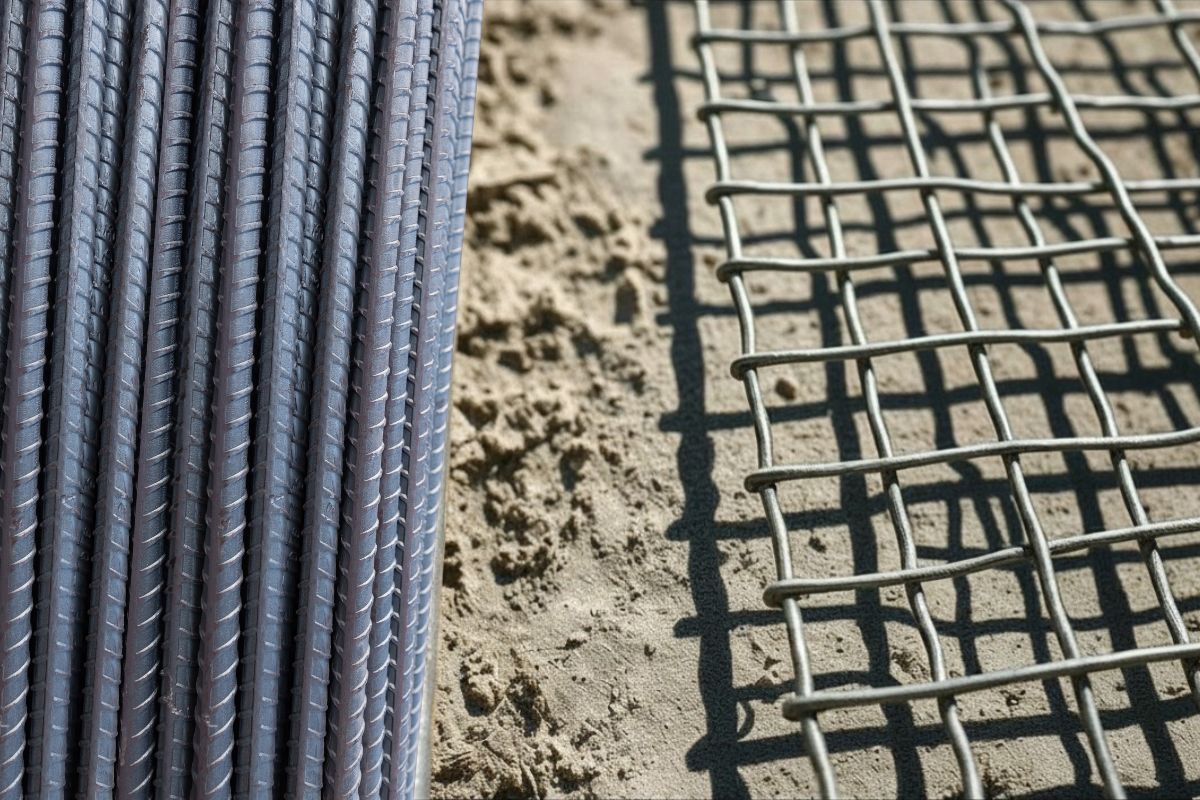
Wire mesh — also called welded wire fabric — is a grid of thin steel wires welded at intersections, sold in flat sheets or rolls. It’s commonly used as driveway reinforcement because it’s inexpensive and fast to install. It’s also significantly less effective than rebar in High Desert residential applications, for two related reasons.
First, wire mesh is thin — typically made from wire gauges that provide a fraction of the cross-sectional steel area of #3 or #4 rebar. Less steel means less tensile capacity at any given point in the slab. Under the bending forces of vehicle loads and the soil movement forces common in High Desert expansive soil conditions, thin wire provides inadequate resistance compared to properly sized rebar.
Second, wire mesh almost always ends up at the bottom of the slab during placement. Mesh rolls have a natural curl that resists laying flat. When workers walk on it during the pour and when concrete is placed over it, mesh displaces downward. The result is reinforcement at the bottom of the slab — in the compression zone — rather than at mid-depth where tension forces require it. A slab with wire mesh at the bottom is effectively unreinforced in the zone that matters most.
| Factor | Rebar on Chairs | Wire Mesh |
| Steel cross-section | High (#3 = 0.11 sq in, #4 = 0.20 sq in) | Low (thin wire gauge) |
| Placement consistency | Held at correct depth by chairs | Typically sinks to bottom of slab |
| Tensile reinforcement effectiveness | High — positioned in tension zone | Low — in compression zone |
| Resistance to soil movement forces | Strong | Weak |
| Cost premium over wire mesh | Moderate | Baseline |
| Recommended for High Desert | Yes — standard for Viva Concrete | Not recommended |
Why High Desert Soil Conditions Make Reinforcement More Critical
In stable soil conditions with minimal ground movement, an unreinforced or lightly reinforced concrete slab can perform adequately for years because the forces acting on it are primarily vertical vehicle loads. In the High Desert, there’s a second force at work: the horizontal and vertical movement of expansive soils beneath the slab.
When the clay and sand soils common beneath driveways in Adelanto, Phelan, and parts of Hesperia absorb moisture from rainfall or irrigation, they swell. When they dry out in the summer heat, they contract. This repeated movement creates bending and tensile forces in the slab from below — forces that rebar is specifically designed to resist and that wire mesh handles inadequately.
A driveway built on High Desert expansive soil without proper rebar reinforcement is one where the question isn’t whether cracking will occur — it’s when. Proper reinforcement doesn’t eliminate all cracking risk, but it dramatically extends the service life of the slab by resisting the forces that initiate structural cracks.
Rebar Spacing and Grid Configuration
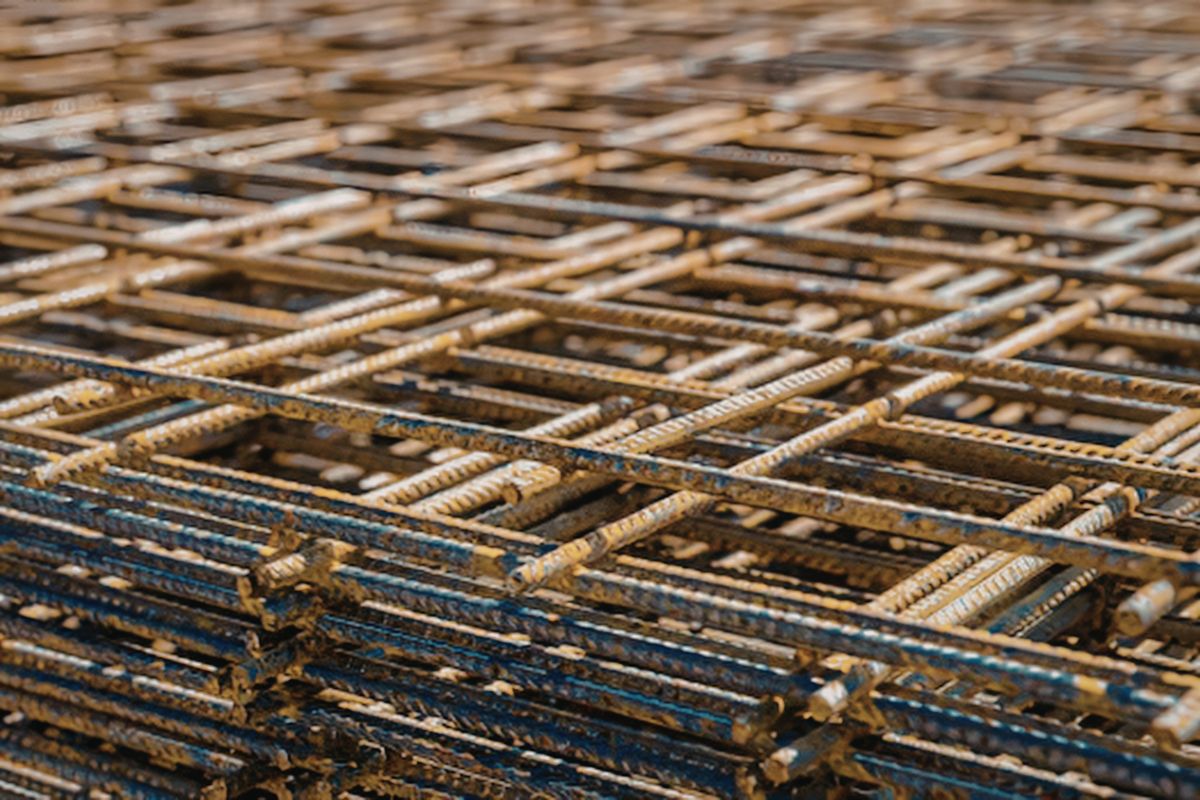
Rebar reinforcement is installed in a grid pattern — bars running in two perpendicular directions create a mesh of steel at mid-depth of the slab. Standard spacing for residential driveways is 18 inches on center in both directions, creating an 18 x 18 inch grid. For driveways designed to support heavier loads — RVs, loaded trucks, or vehicles over 10,000 pounds — tighter spacing of 12 inches on center provides greater reinforcement density.
For RV pads and heavy vehicle driveways in Apple Valley and Oak Hills — where large recreational vehicles and work trucks are common — Viva Concrete increases rebar to #4 on a 12-inch grid to match the load requirements. The post on concrete driveway thickness for RVs and trucks covers the full specification for heavy vehicle applications.
Rebar in Other Concrete Applications
The same principles that apply to driveway reinforcement extend across all concrete work. Foundations and residential slabs use heavier rebar in denser grids because the structural stakes are higher. Retaining walls use rebar sized and spaced to resist the lateral soil pressure they’re designed to hold. Pool decks use rebar to resist the thermal movement and moisture exposure inherent in pool environments.
Across all of Viva Concrete’s services — from foundations and residential slabs to concrete retaining walls to concrete pool decks — rebar specification is determined by the structural demands of each application rather than defaulting to the minimum that satisfies a basic inspection.
What to Ask Your Contractor Before Signing
Before committing to any concrete driveway project, homeowners in the High Desert should ask their contractor two specific reinforcement questions: What size rebar are you using? And how are you ensuring it stays at mid-depth during the pour?
A contractor who specifies wire mesh, or who places rebar without chairs, is delivering a lower-quality structural product than the High Desert’s soil conditions warrant — regardless of how competitive their price is. The concrete surface will look identical at installation. The difference shows up in year 10 or 15 when cracking patterns reveal what was or wasn’t properly reinforced underneath.
Viva Concrete provides transparent, written quotes that specify exactly what PSI mix is being used, how much rebar is being installed, and how it will be positioned. This level of detail is part of the company’s commitment to absolute transparency on every project. To get a free written estimate for your driveway in Victorville, Hesperia, Barstow, Rancho Cucamonga, or anywhere across the High Desert service area, call +1 323 209 0101 or reach out through the contact page.
Viva Concrete is the High Desert’s concrete authority. Visit the concrete driveway service page or call +1 323 209 0101 for a free estimate.