Concrete driveways in the High Desert take a beating that driveways in milder climates simply don’t face. Summer surface temperatures exceeding 150°F, freezing winter nights, expansive desert soils that shift seasonally, and relentless UV exposure all accelerate concrete deterioration. The result is that even a well-built driveway has a finite lifespan — and there comes a point where repair and resurfacing no longer make economic sense.
The challenge is knowing when that point has arrived. Minor cracking and surface wear are normal and repairable. Structural failure is not. This post covers the five signs that indicate your concrete driveway has crossed from maintenance territory into replacement territory — and what each one means for the decision ahead.
Sign 1: Large, Widespread Cracking Across Multiple Sections
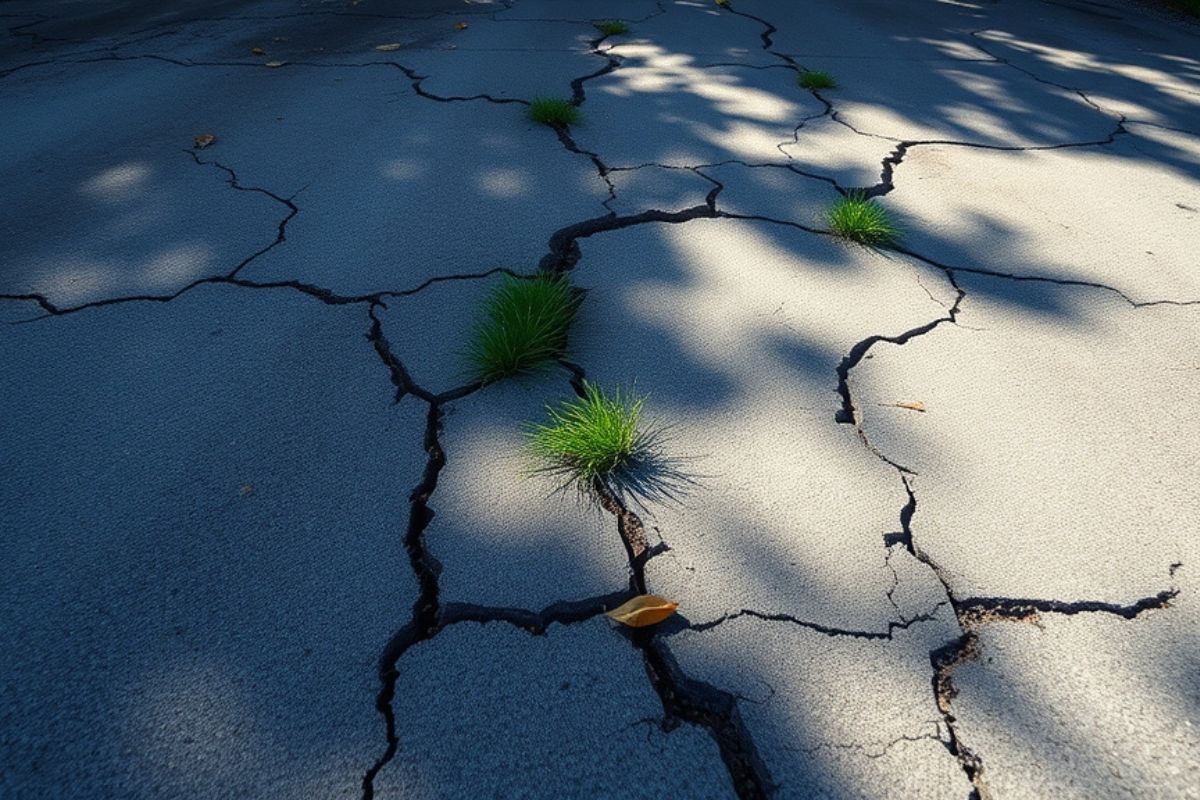
Not all cracks are equal. A single hairline crack along a control joint is normal — it’s doing exactly what the joint was designed to do. A few isolated surface cracks from shrinkage are cosmetic and easily filled. But when cracking has spread across multiple sections of the driveway, when cracks are wider than a quarter inch, or when a web of cracks is visible across most of the surface, the driveway has moved from manageable maintenance to structural failure.
Widespread cracking in a High Desert driveway typically signals one of two underlying problems: the original subgrade preparation was inadequate and the soil has shifted under the slab, or the concrete mix was insufficient for the thermal stress of the Mojave climate. In either case, filling or resurfacing over widespread structural cracks is a temporary cosmetic fix. The underlying problem continues, the new surface cracks again quickly, and the homeowner ends up paying for resurfacing plus eventual replacement rather than just replacement.
When cracking is widespread and structural, replacement with proper subgrade preparation is the right investment. Viva Concrete’s concrete driveway installation service addresses the underlying soil conditions that caused the original failure — not just the surface. Learn more about our engineering-first approach on the High Desert Heritage & Excellence page.
Sign 2: Significant Settling, Heaving, or Uneven Sections
A concrete driveway that has developed noticeable elevation changes — sections that have sunk below grade, panels that have heaved upward, or edges that have separated and shifted — is showing signs of subgrade failure. In Victorville and Hesperia, this most commonly happens when sandy or clay-heavy soils beneath the slab have eroded, compressed, or expanded unevenly over time.
Minor settling can sometimes be addressed through mudjacking or slab lifting — a process that injects material beneath a sunken slab to restore its level. But significant heaving, or settling that has caused sections to shift by more than an inch, usually indicates that the subgrade has failed comprehensively enough that lifting the existing slab will not produce a durable result. The slab needs to come out, the subgrade needs to be properly excavated and recompacted, and a new slab needs to be poured on a prepared base.
Uneven sections also create trip hazards that are a liability consideration for homeowners — particularly at the transition from driveway to garage floor or sidewalk. If your driveway in Apple Valley or Hesperia shows significant height differentials between panels, a professional assessment is worth scheduling before someone gets hurt.
Sign 3: Spalling or Scaling That Has Penetrated Beyond the Surface Layer
Spalling is the flaking or pitting of the concrete surface, where the top layer separates and breaks away. Surface-level spalling — affecting only the top quarter inch or less — can often be addressed with a polymer-modified overlay or resurfacing treatment. But when spalling has penetrated deeper, exposing aggregate, revealing rebar, or creating pitting that compromises the slab’s profile, resurfacing no longer creates a durable bond with the compromised substrate.
In the High Desert, severe spalling is often the result of years of thermal cycling — the repeated expansion and contraction of the slab through extreme temperature ranges that eventually delaminates the surface from the body of the concrete. Once this process has progressed past the surface layer, the structural integrity of the slab is compromised and replacement is the appropriate response. Viva Concrete’s concrete repair and resurfacing service can assess whether your slab qualifies for an overlay or requires full replacement.
Sign 4: Drainage Problems Causing Persistent Water Pooling
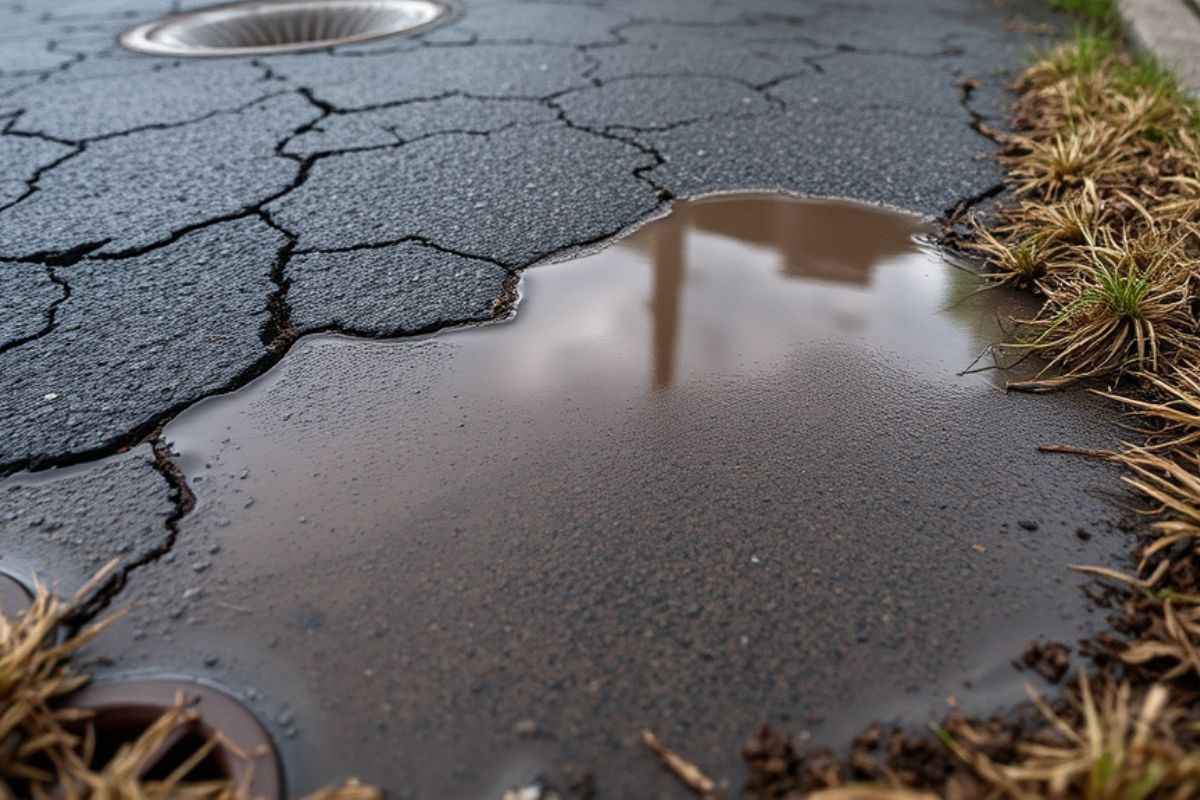
A concrete driveway that pools water rather than draining it away from the structure has a grading or settling problem that goes beyond surface condition. Water that sits against the garage foundation, pools near the house, or infiltrates beneath the slab edge is actively damaging the structure it’s supposed to protect.
In the High Desert, drainage problems are particularly consequential because of the expansive soil conditions. Water infiltration beneath a slab triggers the swell-and-shrink cycle in clay-heavy soils that causes cracking and settling. A driveway with persistent drainage problems is one that’s actively accelerating its own deterioration — and potentially directing water toward the home’s foundation.
Drainage issues that result from settling or original grading errors generally cannot be corrected through resurfacing. The slab’s grade is determined by the subgrade beneath it. Correcting a drainage problem means addressing the subgrade — which means demolition and replacement with proper laser-leveling during installation. This is standard practice on every Viva Concrete driveway project in Victorville and across the High Desert service area.
Sign 5: The Driveway Is 30 or More Years Old With Multiple Repair Cycles
Concrete driveways in the High Desert, when properly built and maintained, can last 30 to 50 years. But a driveway that has already been patched, resurfaced, and repaired multiple times across a 30-plus year lifespan is approaching the end of its practical life regardless of whether any single issue appears severe enough to justify replacement on its own.
The cumulative effect of thermal cycling, UV exposure, and soil movement over three decades degrades the internal structure of the concrete — not just the surface. At a certain point, additional repairs and resurfacing are no longer cost-effective compared to a new installation that will serve the property for another 30 to 50 years.
For homeowners in Phelan, Oak Hills, or Barstow with aging driveways that have seen multiple repair cycles, an honest assessment from a qualified contractor is the best starting point before investing further in a slab that may be past its service life.
Replacement vs Resurfacing: How to Decide
If one or two of the signs above apply, concrete driveway resurfacing may still be worth evaluating — particularly if the underlying slab is structurally sound and the issues are primarily cosmetic. If three or more of the signs above apply, or if any of the structural issues — widespread cracking, significant settling, drainage failure — are present, replacement is the right conversation to have.
Viva Concrete provides free on-site assessments across Victorville, Apple Valley, Hesperia, Adelanto, and the surrounding High Desert communities. A walkthrough of your existing driveway gives a clear, honest picture of whether repair, resurfacing, or full replacement is the most cost-effective path forward. Call +1 323 209 0101 or reach out through the contact page to schedule.
Viva Concrete is the High Desert’s concrete authority. Visit the concrete driveway service page or call +1 323 209 0101 for a free on-site estimate.