When High Desert homeowners start planning a patio, driveway, or outdoor living area, two decorative options consistently come up side by side: stamped concrete and pavers. Both can look exceptional. Both are significant investments. And in Victorville, Apple Valley, and Hesperia, both are subject to the same extreme climate conditions that expose the real-world performance differences between them.
This comparison is built specifically for the High Desert — not a generic national overview. The Mojave Desert’s expansive soils, extreme heat, intense UV, and temperature cycling create conditions where the strengths and weaknesses of each material show up faster and more clearly than in milder climates. Understanding how they perform here is what makes the decision clear.
What Each Material Is
Stamped Concrete
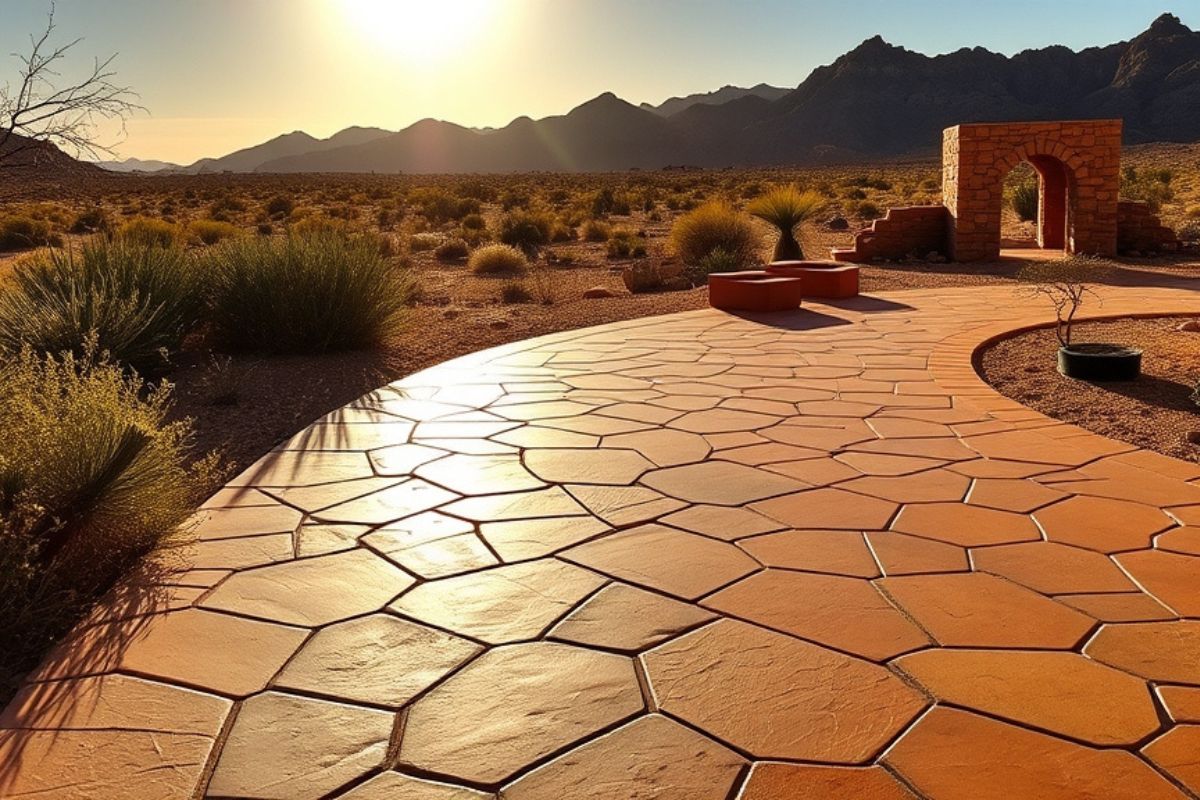
Stamped concrete is a monolithic concrete slab with a decorative surface impression — pattern and color applied to the fresh concrete before it sets. The slab is continuous, reinforced with rebar, and poured over a properly prepared subgrade. The pattern, which can replicate slate, cobblestone, flagstone, brick, or wood, is an impression in the concrete itself rather than a coating on top.
Stamped concrete patios, driveways, pool decks, and walkways are among the most requested services at Viva Concrete across Victorville, Apple Valley, and Hesperia because the combination of durability and visual impact is difficult to match at the same price point.
Pavers
Pavers are individual units — concrete, clay brick, or natural stone — laid over a compacted sand or gravel base in a defined pattern. Unlike a poured slab, a paver surface is made up of many separate pieces with joints between them filled with sand or polymeric jointing material. The individual units can be replaced if damaged, and the surface can theoretically be lifted and reset if the base settles.
Performance in the High Desert Climate
Heat and UV
Both materials absorb solar radiation and reach high surface temperatures in Victorville’s summer heat — this is a function of color and surface texture more than material type. Lighter-colored surfaces run cooler than darker ones regardless of whether they’re stamped concrete or pavers.
Where UV affects the two differently is in appearance maintenance. Stamped concrete’s color depends on a sealer film that UV radiation degrades over time. In the High Desert, this means resealing every two to three years to maintain color depth — using UV-stable products specifically rated for Mojave Desert exposure. Concrete pavers have color integral to the unit itself, which fades more slowly under UV but still requires periodic sealing to maintain appearance and protect against surface erosion.
Expansive Soil Performance
This is the most significant performance differentiator for High Desert applications. The expansive soils common beneath properties in Victorville, Hesperia, and Adelanto swell when wet and contract when dry — creating vertical movement beneath any installed surface.
Stamped concrete responds to soil movement as a unit — the entire slab moves together, and cracking is managed through control joints that direct movement to planned locations. A properly reinforced and jointed stamped concrete slab on a well-prepared subgrade handles High Desert soil movement reliably over decades.
Pavers respond to soil movement as individual units — and they respond unevenly. As the base settles or heaves in different areas, individual pavers shift at different rates, creating an uneven surface with raised edges, sunken sections, and widening joints. In the High Desert’s active soil environment, paver surfaces typically require releveling within five to ten years. The jointing sand that fills paver gaps also erodes under the same thermal cycling and wind conditions, requiring periodic replenishment. Homeowners in Adelanto and Phelan — where soil movement is particularly active — see this paver maintenance requirement more acutely than in stable-soil markets.
Thermal Expansion
Both materials expand and contract with temperature changes. Stamped concrete manages this through control joints — planned weak points that accommodate movement without random cracking. Pavers manage it through the flexibility of the joint system — the sand or polymeric fill between units can compress and expand as individual units move. In practice, pavers tolerate thermal movement slightly better than a poorly jointed concrete slab, but a properly jointed stamped concrete slab handles thermal cycling reliably.
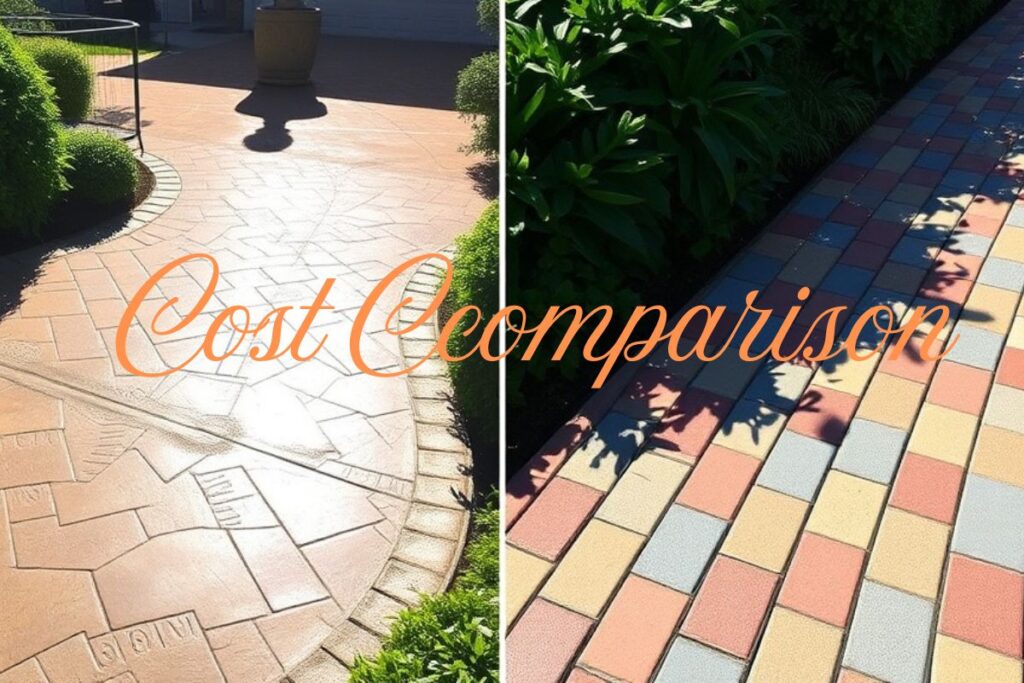
Cost Comparison in the High Desert
| Factor | Stamped Concrete | Concrete Pavers |
| Installation cost/sq ft | $10 – $25 | $15 – $30 |
| 500 sq ft patio estimate | $5,000 – $12,500 | $7,500 – $15,000 |
| Subbase preparation | Required — full excavation | Required — gravel + sand base |
| Repair cost (isolated damage) | Moderate — visible patch | Low — replace individual units |
| Releveling cost (settlement) | Mudjacking or replacement | Lift, recompact, reset |
| Sealing requirement | Every 2–3 years (UV-stable) | Every 3–5 years |
| Joint maintenance | Control joints — minimal | Sand replenishment — periodic |
| Lifespan (High Desert) | 25 – 40 years | 20 – 35 years |
| Color/pattern options | Very wide — custom colors | Wide — limited to unit colors |
Repairability: The Trade-Off That Matters
The most frequently cited advantage of pavers over stamped concrete is repairability — if a paver is cracked or stained, it can theoretically be removed and replaced without affecting the surrounding surface. This is accurate but more complicated in practice than it sounds.
Matching replacement pavers to an existing installation that has weathered and faded over years is difficult. Pavers from the same original batch fade at different rates than new units, making patches visible. Older product lines are sometimes discontinued, making exact matches impossible.
Stamped concrete patches are also visible — matching an existing stamped surface exactly is challenging. The honest comparison is that both materials show repairs over time, and the severity depends on how large the damaged area is and how much the surface has aged since installation. Neither offers truly invisible repair after years of weathering.
Appearance: Which Looks Better?
This is subjective — but there are objective differences in what each material can achieve. Stamped concrete offers virtually unlimited pattern and color customization. Complex multi-pattern layouts with integrated border designs and multiple color treatments produce results that pavers simply cannot replicate because the design exists in a continuous poured surface rather than individual units with visible joints.
High-quality natural stone or clay brick pavers have an authenticity of material that stamped concrete replicates but doesn’t fully duplicate at close inspection. For homeowners who value the genuine material quality of real stone or clay, pavers deliver something stamped concrete cannot — even the best stamped work is still an impression in concrete rather than real stone.
For most High Desert residential projects, the visual difference between quality stamped concrete and quality pavers is minimal from normal viewing distances. The decision usually comes down to cost, maintenance preference, and which material better suits the specific design vision. Viva Concrete’s stamped and decorative concrete portfolio shows completed projects across the full range of patterns and color treatments available.
Which Is Right for Your High Desert Project?
Stamped concrete is the stronger choice when budget efficiency matters, when design flexibility and custom color treatment are priorities, or when the project is on a property with active soil movement where a monolithic slab performs more predictably than a jointed paver system. It’s also the clear choice when the project area is large enough that paver costs become prohibitive.
Pavers are worth considering when individual unit replaceability is important — particularly for pool coping areas or surfaces adjacent to utility access points where occasional disruption is likely. They’re also appropriate when a genuine material quality distinction over stamped concrete matters to the homeowner, and the budget supports the higher upfront investment.
For most patio, driveway, pool deck, and walkway projects in Victorville, Apple Valley, Hesperia, Oak Hills, Barstow, and Rancho Cucamonga, stamped concrete delivers better value over the project’s lifecycle — lower upfront cost, predictable behavior in High Desert soil conditions, and a wider design range. To discuss your specific project and get a free written estimate, call +1 323 209 0101 or reach out through the contact page.
Viva Concrete is the High Desert’s concrete authority. Visit the stamped concrete service page or call +1 323 209 0101 for a free estimate.