Stamped concrete lifespan is one of the most common questions homeowners ask before committing to a decorative concrete project — and one of the most variable to answer honestly. The range between a stamped surface that starts failing within five years and one that looks and performs well after 35 is not random. It’s the direct result of specific decisions made during installation and specific maintenance actions taken over the life of the surface.
In the High Desert, the Mojave Desert’s climate creates conditions that compress that timeline — accelerating failure in poorly installed or neglected stamped concrete, and rewarding well-built, properly maintained surfaces with exceptional longevity. This post covers what determines how long stamped concrete lasts in Victorville, Apple Valley, and Hesperia, what breaks down first when maintenance is skipped, and what the realistic lifespan expectations are for each scenario.
The Two-Layer Reality of Stamped Concrete Lifespan
Stamped concrete has two distinct components with different lifespans: the structural slab underneath and the decorative surface treatment on top. Understanding the difference between them is key to having accurate expectations.
The structural slab — the concrete itself, reinforced with rebar and poured over a prepared subgrade — has the same lifespan as any other properly built concrete installation. In the High Desert, a well-built stamped concrete slab can last 30 to 50 years structurally. The concrete doesn’t care whether it’s stamped or plain — its longevity is determined by the same factors that govern any concrete installation: subgrade preparation, mix quality, reinforcement, and curing.
The decorative surface treatment — the pattern impression, color, and sealer — has a shorter, more maintenance-dependent lifespan. The sealer film that protects the color and enhances the pattern needs periodic renewal. The color itself, particularly in sun-exposed High Desert applications, fades over time without UV protection. This is the layer that requires active maintenance — and the one that fails visibly before the slab beneath it does.
What the Mojave Desert Does to Stamped Concrete
UV Radiation and Color Degradation
The High Desert receives among the highest UV radiation levels in the continental United States. Stamped concrete’s color depends on pigments embedded in the concrete and a sealer film on the surface — both of which UV radiation actively degrades. An unsealed or under-sealed stamped surface in Victorville will begin showing visible color fading within one to two years of installation. After five years without resealing, significant color loss and surface chalking are typical.
This is why UV-stable products are not optional for High Desert stamped concrete — they’re the baseline. Viva Concrete uses pigments and sealers specifically formulated for high-UV environments, not the standard coastal California products that fade faster under Mojave Desert sun exposure.
Thermal Cycling and Surface Stress
Victorville’s temperature range — from sub-freezing winter nights to 110°F summer afternoons — puts more cumulative thermal stress on a stamped surface than most California climates. The sealer film on stamped concrete expands in heat and contracts in cold, and over years of cycling it develops micro-cracks that reduce its protective effectiveness. Resealing renews the protective film before these micro-cracks allow moisture and UV to reach the underlying color.
Expansive Soil Movement
The expansive soils common beneath properties in Victorville, Hesperia, and Adelanto create vertical movement beneath concrete slabs as they swell and contract seasonally. Properly reinforced stamped concrete on a well-prepared subgrade handles this movement through control joints. Stamped concrete on an inadequately prepared subgrade develops structural cracks that compromise both the decorative surface and the slab beneath it — cracking that can appear within the first few years on poorly built installations.
Realistic Lifespan Scenarios for High Desert Stamped Concrete
| Installation & Maintenance Scenario | Decorative Lifespan | Structural Lifespan |
| Proper install + UV-stable products + resealing every 2–3 yrs | 25 – 35 years | 35 – 50 years |
| Proper install + standard products + consistent resealing | 15 – 25 years | 30 – 45 years |
| Proper install + standard products + minimal maintenance | 5 – 10 years | 25 – 40 years |
| Inadequate subgrade prep + any product | 2 – 7 years (cracking) | 10 – 20 years |
| Proper install + no maintenance at all | 3 – 8 years (fading + sealer failure) | 25 – 40 years |
The decorative lifespan refers to how long the surface maintains its intended appearance — color depth, pattern clarity, and consistent sheen. The structural lifespan refers to how long the slab remains functional without significant cracking or settling. These timelines diverge because a slab can remain structurally sound long after its decorative treatment has faded beyond acceptable appearance.
What Breaks Down First — and When
Year 1 to 3: Sealer Wears
The first sign of maintenance need in any stamped concrete surface is sealer wear — the protective film thins, loses sheen, and begins to show dull patches. In the High Desert, this timeline is shorter than in milder climates because UV radiation and thermal cycling degrade the sealer faster. A properly sealed surface in Victorville should be resealed at the two-year mark, not the five-year mark that might be appropriate in a coastal California application.
Year 3 to 7 Without Resealing: Color Fading
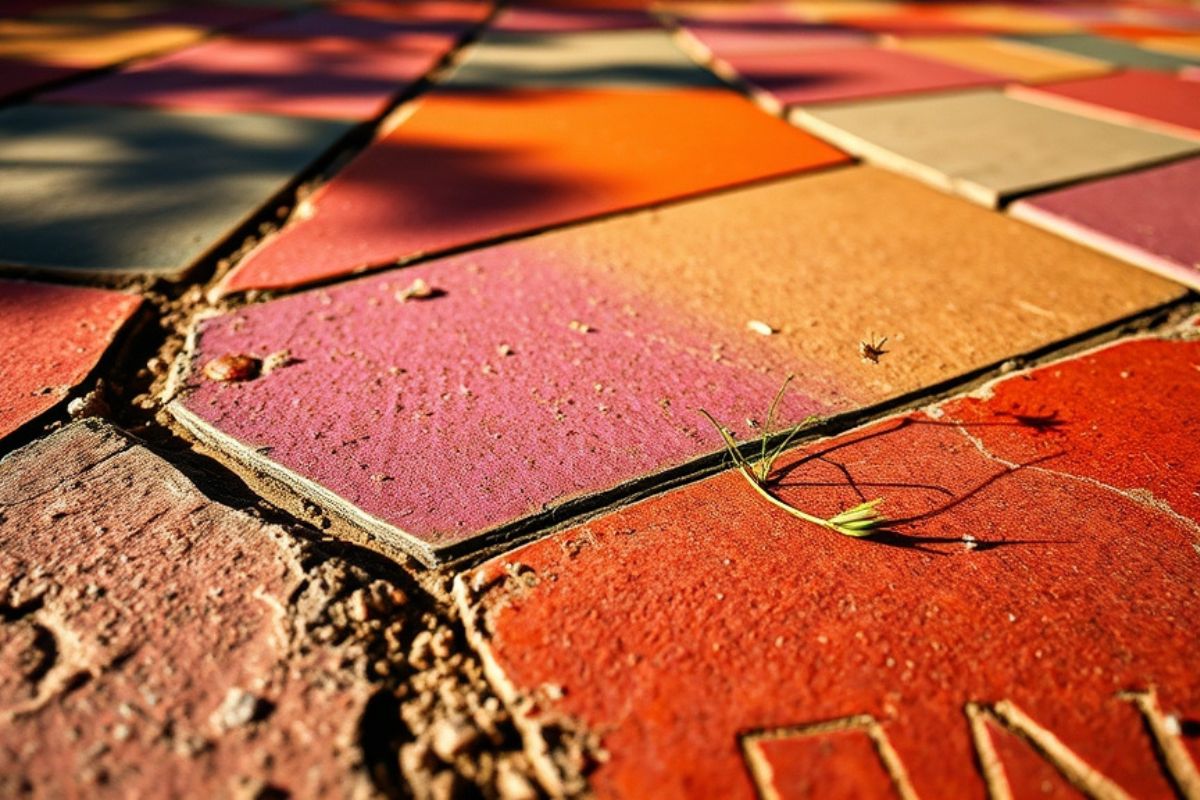
As the sealer thins and fails, UV radiation reaches the color layers more directly. Integral color in the concrete itself fades more slowly than surface-applied release agents, but both lose depth and richness over time without sealer protection. High Desert stamped surfaces that aren’t resealed on schedule show significant color fade within three to seven years — the warm desert tones and rich contrasts that defined the installation begin to flatten into a uniform gray-tan surface.
Year 5 to 15 Without Maintenance: Surface Erosion
Without periodic sealing, the cement matrix near the surface of the slab begins to erode under UV and traffic exposure. The aggregate within the concrete becomes more exposed, the pattern impression loses some of its depth, and the surface becomes more porous — allowing oil, water, and staining to penetrate more easily. This surface erosion is progressive and accelerates once it starts.
Structural Cracking: Timeline Depends on Installation Quality
Structural cracking in stamped concrete — cracks that run through the slab depth rather than just the surface — is not primarily a maintenance issue. It’s an installation quality issue. Stamped concrete poured over properly prepared subgrade with adequate reinforcement and correct control joint placement develops structural cracks rarely, if at all, over decades of High Desert service. Stamped concrete poured over inadequate subgrade can show structural cracking within two to five years regardless of how well the surface is maintained. The post on how to prevent concrete from cracking covers the installation factors that determine structural crack risk in detail.
How to Maximize Your Stamped Concrete’s Lifespan
The maintenance actions that most directly extend stamped concrete lifespan in the High Desert are straightforward, but they require consistency rather than intensity.
Professional resealing every two to three years is the single most impactful maintenance step. In the High Desert, this interval should be treated as a maximum, not a target — if the surface shows significant sheen loss or color fading before the two-year mark, reseal sooner. Viva Concrete’s concrete repair and maintenance services include professional resealing with UV-stable products appropriate for Mojave Desert applications.
Keeping the surface clean of oil, grease, and chemical stains reduces surface penetration and staining that compounds over time. A gentle wash with a low-pressure hose and mild detergent addresses surface contamination without damaging the sealer film.
Avoiding heavy impact or point loading — furniture legs without protective pads, dropped tools, vehicle jacks — prevents localized cracking of the sealer and surface layer that provides entry points for moisture and UV.
Getting the Most From Your Investment
Homeowners in Apple Valley, Oak Hills, Phelan, Barstow, and Rancho Cucamonga who want stamped concrete that genuinely lasts in High Desert conditions start with the right installation — proper subgrade prep, UV-stable products, and rebar reinforcement — and follow through with consistent resealing. Both elements are necessary. Neither substitutes for the other.
For a free consultation on a new stamped concrete project or an assessment of an existing installation, call +1 323 209 0101 or reach out through the contact page. Viva Concrete’s stamped and decorative concrete services include installation, resealing, and restoration across the full High Desert service area.
Viva Concrete is the High Desert’s concrete authority. Visit the stamped concrete service page or call +1 323 209 0101 for a free estimate.