Concrete driveway thickness is one of the most consequential decisions in any driveway project — and one that most homeowners never think to ask about until after something goes wrong. In the High Desert, where soil movement, extreme heat, and heavy vehicles are all common, getting the thickness right from the start determines whether your driveway lasts 15 years or 40.
The answer depends on what the driveway needs to support. A standard passenger vehicle driveway has different requirements than one that regularly carries an RV, a loaded pickup truck, a boat trailer, or commercial delivery vehicles. This post covers the thickness specifications for each use case, explains why the Mojave Desert’s soil conditions push those requirements higher than national standard recommendations, and breaks down what reinforcement belongs at each thickness level.
Standard Driveway Thickness: What the Industry Recommends vs What the High Desert Requires
The nationally cited standard for residential concrete driveways is 4 inches thick. In many parts of the country — stable soil conditions, mild climate, passenger vehicles only — 4 inches is adequate. In Victorville, Apple Valley, Hesperia, and the surrounding High Desert communities, 4 inches is the minimum, not the target.
High Desert soil conditions introduce two variables that push thickness requirements upward. First, the expansive soils common across the region — clays and sands that swell when wet and contract when dry — create seasonal movement beneath the slab that 4-inch concrete handles less reliably than 5 or 6 inches. Second, the extreme thermal cycling of the Mojave Desert — from below-freezing winter nights to 110°F summer days — puts more cumulative stress on a thinner slab than on a thicker one over the same period.
Viva Concrete’s standard specification for residential driveways in the High Desert is 5 inches, not 4. For properties in areas with known challenging soil conditions — including parts of Adelanto, Phelan, and the sandy basins surrounding Victorville — 5 inches with #4 rebar on chairs is the baseline recommendation before vehicle load is even considered.
Thickness Requirements by Vehicle Type
Passenger Vehicles Only
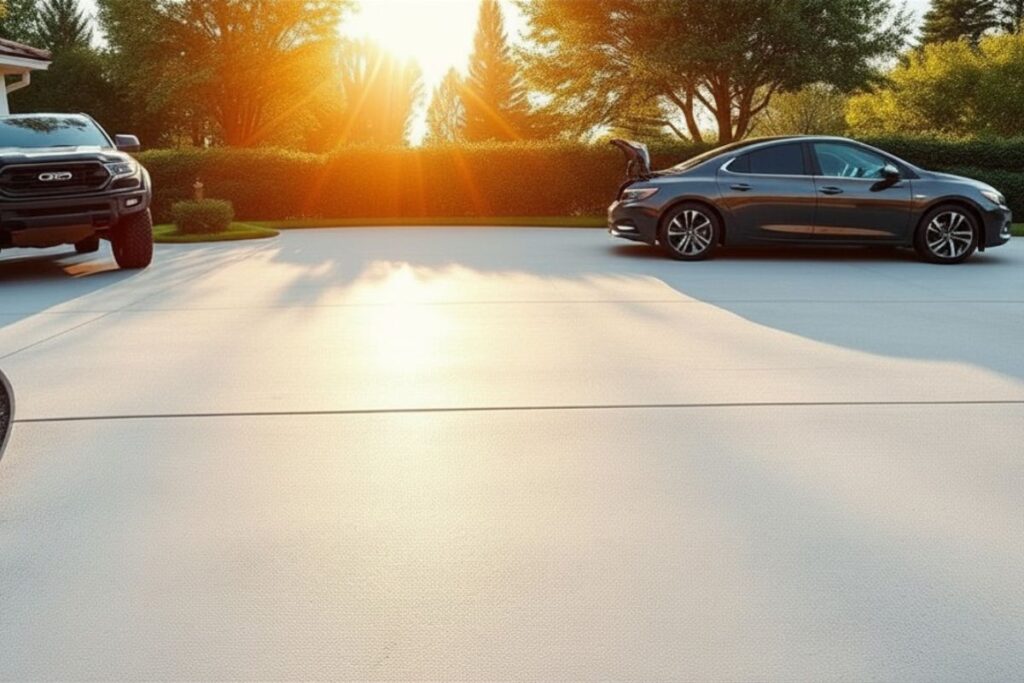
For a driveway that will see only standard passenger cars and light SUVs, 4 to 5 inches with #3 or #4 rebar on chairs is appropriate for High Desert conditions. Wire mesh — the default reinforcement used by many contractors — is not adequate for High Desert applications because it typically sinks to the bottom of the slab during the pour, providing no tensile reinforcement where it matters most. Rebar on chairs ensures the steel is suspended at mid-depth of the slab where it provides maximum structural benefit.
Pickup Trucks and SUVs
Full-size pickup trucks — particularly loaded trucks or those towing trailers — exert significantly more load per wheel than a passenger car. For driveways that regularly support full-size pickups, 5 inches with #4 rebar on chairs is the recommended specification in the High Desert. This thickness provides adequate load distribution across Mojave Desert soil conditions without requiring the commercial-grade specifications needed for heavier vehicles.
RVs — Class A, B, and C Motorhomes
This is where thickness requirements change substantially. A Class A motorhome can weigh 30,000 to 40,000 pounds fully loaded. A Class C typically runs 12,000 to 26,000 pounds. These are not loads that a standard residential driveway specification can support reliably — particularly on the expansive soils common in Apple Valley and Hesperia, where the combination of vehicle weight and soil movement creates exceptional stress on undersized slabs.
For RV pads and driveways that need to support motorhomes, Viva Concrete specifies 6 inches of concrete minimum with #4 rebar on a 12-inch grid spacing, poured at 4,000 PSI or higher. The subgrade preparation for an RV application also goes deeper — typically 6 to 8 inches of compacted base material rather than the 4 inches standard for passenger vehicle driveways. This is part of the engineering-first approach that defines Viva Concrete’s work across Apple Valley and the wider High Desert service area.
Boat Trailers and Recreational Equipment
Boat trailers, ATV trailers, and utility trailers with loaded weights above 5,000 pounds should be treated similarly to RV pads from a thickness standpoint. The concentrated load at trailer tongue and wheel contact points creates point loading that thinner slabs handle poorly. Five to six inches with #4 rebar is appropriate depending on the maximum trailer load and frequency of use.
Commercial and Semi-Truck Applications
For driveways or aprons that need to support delivery trucks, semi-trailers, or commercial vehicles, residential driveway specifications are not appropriate. Commercial vehicle loads require a minimum of 6 to 8 inches with heavy rebar grids and higher PSI concrete mixes. Viva Concrete’s commercial concrete services cover these applications with specifications appropriate to vehicle weight, axle configuration, and site conditions.
Thickness and Reinforcement: The Full Specification Table
| Vehicle Type | Thickness | Reinforcement | PSI Mix | Subbase |
| Passenger cars / light SUVs | 4 – 5 in | #3 or #4 rebar on chairs | 3,500 – 4,000 | 4 in compacted |
| Full-size pickups / loaded trucks | 5 in | #4 rebar on chairs | 4,000 | 4 – 6 in compacted |
| Class B / C RVs (under 18,000 lbs) | 5 – 6 in | #4 rebar, 18″ grid | 4,000 | 6 in compacted |
| Class A RVs (over 18,000 lbs) | 6 in | #4 rebar, 12″ grid | 4,000+ | 6 – 8 in compacted |
| Boat / ATV trailers (over 5,000 lbs) | 5 – 6 in | #4 rebar on chairs | 4,000 | 5 – 6 in compacted |
| Commercial / delivery vehicles | 6 – 8 in | Heavy rebar grid | 4,500+ | 8 in compacted |
Why Rebar on Chairs Matters More Than Thickness Alone
Thickness and reinforcement work together — one without the other doesn’t deliver the full structural benefit. A 6-inch slab with wire mesh at the bottom provides less effective reinforcement than a 5-inch slab with #4 rebar properly positioned at mid-depth on chairs.
Concrete is strong in compression — it resists being crushed — but weak in tension — it cracks when pulled or bent. Rebar provides tensile strength, resisting the bending forces that vehicle loads and soil movement create. For that tensile reinforcement to work, the steel needs to be at the center of the slab where bending stress is highest. Wire mesh that has sunk to the bottom of the pour is reinforcing the compression zone where concrete is already strong — not the tension zone where it needs help.
This is why Viva Concrete uses #3 or #4 rebar on chairs for every residential driveway in the High Desert, regardless of the specific application. It’s part of the engineering-over-guesswork philosophy that distinguishes the company’s work from contractors who use wire mesh as a cost-cutting measure. Learn more about Viva Concrete’s approach and local expertise.
The Subgrade Factor: Thickness Only Works on a Prepared Base
All of the thickness specifications above assume a properly prepared subgrade. In the High Desert, this means excavation to the required depth, soil treatment where expansive clay content is high, and compaction using vibratory plate equipment to the density required to support the intended load.
A 6-inch RV pad poured over uncompacted sandy soil will crack and settle faster than a 4-inch passenger vehicle driveway poured over properly prepared ground. The concrete thickness is only as effective as the base it’s sitting on — which is why Viva Concrete’s process allocates the majority of project time to subgrade preparation before the first yard of concrete arrives.
Getting the Right Specification for Your Property

The right thickness specification for your driveway depends on your specific vehicle load, your property’s soil conditions, and your long-term use expectations. Viva Concrete provides free on-site assessments across Victorville, Apple Valley, Hesperia, Adelanto, Oak Hills, Phelan, Barstow, and Rancho Cucamonga. A site visit identifies soil conditions, existing drainage patterns, and the correct specification for your vehicle load before any quote is finalized.
To schedule a free assessment and get a written quote for your concrete driveway installation, call +1 323 209 0101 or reach out through the contact page.
Viva Concrete is the High Desert’s concrete authority. Visit the concrete driveway service page or call +1 323 209 0101 for a free estimate.